
Stranded by the Spreadsheet: Nepal's Microgrids and the Blind Spots of Global Finance
By Ayusha Gautam
September 15, 2026
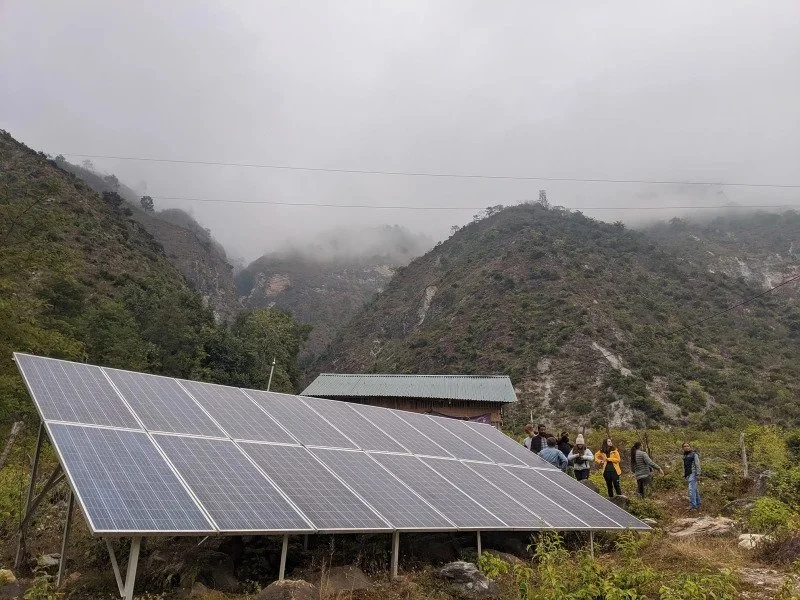
Far from the summits debating net-zero deadlines, Nepal has quietly achieved one of the most remarkable feats in clean energy. Over three decades, it built more than 3,000 decentralized mini-grids, and today it arguably leads the world in the share of its population powered by community-scale renewables. Yet many of these working systems now risk becoming worthless- not from failed technology but from the financial system around them that cannot adequately recognize their worth. The current global financial architecture rewards scale and efficiency while overlooking resilience. Until it learns to price resilience, it will keep stranding the very systems that climate-vulnerable nations need most.
On August 26, a glacier broke off on the Nepal-China border, unleashing flash floods that killed at least 1,380, left 5,500 missing, and affected 84,000. Among the hardest hit were hydropower workers: roughly 900 remain missing across projects on the Trishuli and Bhotekoshi rivers, many believed to be trapped in flooded tunnels. This tragedy illustrates exactly the risk this article aims to highlight: concentrating power generation in a handful of large facilities on high-risk rivers heightens both physical and economic risk. When disaster strikes one site, it cascades, damaging infrastructure, trapping workers, and disrupting power for millions. NASA-NOAA research finds that warming could raise landslide activity by 30 to 70 percent, further illustrating why distributed systems matter. When a mini-grid fails, it affects a local area, but when a hydropower facility fails, it is felt across an entire region. As climate disasters intensify, centralized power on high-risk rivers becomes increasingly precarious.
How Nepal Electrified From the Ground Up
Nepal built one of the world's most extensive decentralized energy networks not by waiting for international finance, but by starting with what it had: rivers, community trusts, and necessity. Local metalworkers shaped turbines from timber and steel, and self-taught engineers had been converting water mills into micro-hydro plants since the 1960s. In Nepal's steep terrain, extending the central grid to every village was never economically feasible, so decentralized systems were the only realistic path. State incentives (1980s) and the Alternative Energy Promotion Centre (1996) then channeled support into thousands more mini-grids. The results have been striking. Household electrification has climbed from barely half the population around 2010 to roughly 99 percent today, and in the 2023/24 fiscal year, Nepal became a net electricity exporter for the first time.
Ironically, the national grid’s expansion threatens those pioneering systems. As the grid reached about 97 percent of electrified households, the mini-grids that had done the hardest work lost their market. Grid integration became the central obstacle, leaving projects at risk of becoming stranded assets with nowhere to sell their power. This problem extends across the Global South. Research across sub-Saharan Africa finds that tariffs undercut mini-grid costs to recover capital and operations, and two-thirds cite tariffs as the biggest barrier to power development. Developers require cost-reflective tariffs, yet flat tariffs prevent this. A market that cannot price the gap between an easy site and a hard one will never value a resilient distributed asset over a fragile centralized one.
The Blind Spot is Global
This blindness is built into the institutions and rules that determine what the world funds, and it operates at several levels. The global institutions created at Bretton Woods in 1944, the IMF and World Bank, sit alongside the regional development banks and donors that financed Nepal’s grids. All of them rely on the same narrow metrics, such as cost per kilowatt-hour, household-access counts, and short donor-funding cycles. These metrics systematically undervalue the natural and local capital on which climate-fragile economies depend. Beyond Bretton Woods is working to change that by drawing attention to this blind spot and pushing for a shift in values. Nepal's predicament is not unique. Across the Global South, locally led systems struggle to attract capital since investment metrics don't value resilience. In an age of climate shocks, that blind spot is a systemic risk.
The cost of that blindness shows up in an unlikely workaround. Some governments mine Bitcoin to wring value from clean power their financial systems cannot otherwise price. Rather than waste surplus hydropower, Bhutan has used its seasonal surplus to mine Bitcoin since 2019. Officials call it a "battery" for wasted electricity; commentators urge Nepal to follow. But it warns as much as it inspires. Bhutan has since sold roughly 70 percent of its holdings as mining inflows faded, and an energy-hungry, volatile currency is an uneasy remedy for a country that prizes ecological resilience. That governments resort to crypto reveals the problem—when finance cannot value stranded power, improvised markets fill the void.
Toward Finance that Values Resilience
The durable answer is pricing resilience directly and building a smarter grid that absorbs decentralized systems instead of stranding them. Resilience is a policy choice. Nepal's systems stayed resilient until policy pushed centralization. Distributed generation raises energy security and cuts transmission losses. As Nepal adds rooftop solar, batteries, and electric vehicles, researchers argue a decentralized, digitized control system is more resilient. With proper standards, mini-grids become grid-ready infrastructure that strengthen the national network.
Nepal's experience points to a clear agenda for regulators and lenders. Regulators should let mini-grids sell power into the grid rather than strand them—as the United States did in 1996, when the Federal Energy Regulatory Commission's open-access orders forced utilities to give independent producers nondiscriminatory grid access. Lenders should design blended finance that prices resilience and local value, not just upfront cost. And the institutions reshaping global finance should treat proven, locally led systems as models to fund rather than anomalies to overlook. Reform will not be written in Washington or Basel alone; it can be assembled from the hills of Nepal and places like them. Electricity reaches those hills. Our task is to build finance that preserves proven, resilient, locally built value.